The Real Rating
3.5 / 5
There is a particular moment — somewhere around the third hour of waiting in a hotel lobby, watching a police car pull up because a member of staff told you to call one yourself — when you stop thinking about thread counts and start thinking about what the stars on the door are actually supposed to mean.
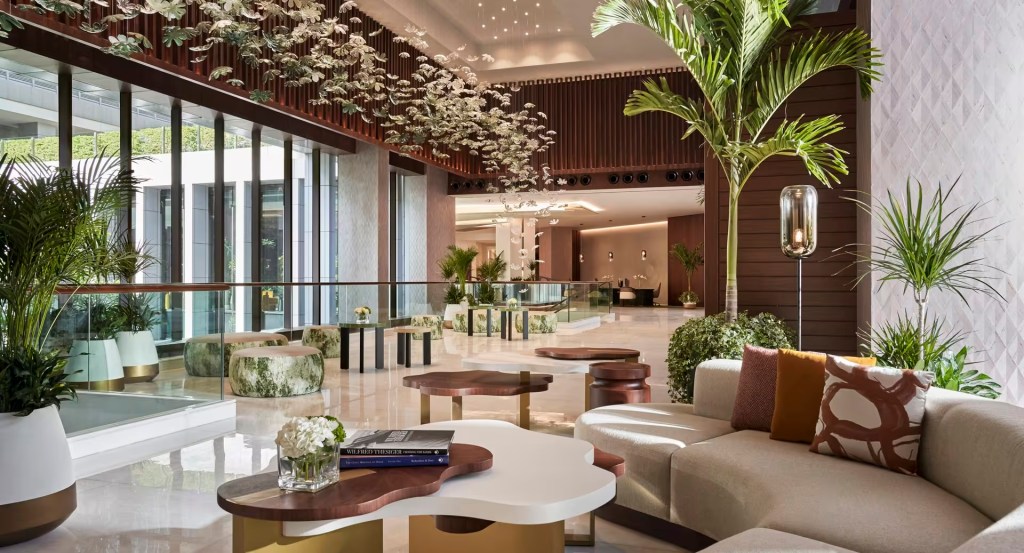
I stayed at the Anantara Downtown Dubai for the first time this year, in a standard room, as a Titanium-tier loyalty member, on a straightforward leisure trip. I had no history with the property, no expectations shaped by a previous visit gone right or wrong — only the promise implied by the rating and the price. Over three days, that promise held in some places and collapsed in others, and the gap between the two turned out to be the more interesting story.
The Building Delivers. The Experience Doesn’t.
Credit where it’s due, because it matters for the argument that follows: the gym was clean and well-kept. The pool was genuinely excellent.


And breakfast, on the plate, was the kind of spread that photographs well and tastes better — generous, varied, the sort of morning buffet a five-star property should be proud to put its name on. But it arrived to the table late, and rushed, through a floor that was visibly understaffed for the volume it was serving. A guest could taste the ambition of the offering and feel the strain of the execution in the same sitting. That contrast — a genuinely impressive product, undercut by a service layer stretched too thin to deliver it properly — turned out to be the theme of the entire stay, not an isolated breakfast complaint.
This is worth dwelling on, because it’s the trap many luxury properties fall into: they invest heavily in what can be photographed — the spread, the plating, the room design — and under-invest in what actually has to be staffed: the person refilling coffee, the person checking a pastry before it leaves the kitchen, the person who remembers a loyalty tier without being reminded.
Day One: The Quiet Erosion of the Basics
The air conditioning in my assigned room wasn’t functioning, so I was relocated to another. Mechanical failures happen even at well-run hotels, and on their own they don’t define a stay. What was harder to overlook was everything that should have accompanied the inconvenience and didn’t: no welcome amenity, no recognition of Titanium status — a tier that, at most hospitality brands, comes with an upgrade when one is available — and no turndown service that evening.
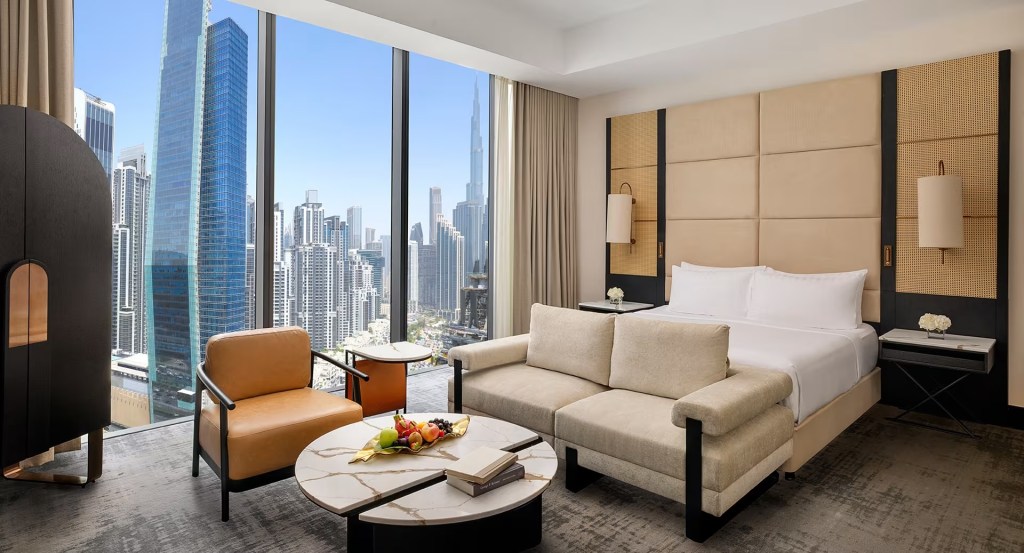
None of these, alone, breaks a stay. Stacked together, on the very first day, they say something quieter and more telling: nobody was tracking the details for this particular guest. In luxury hospitality, the absence of small gestures reads louder than most guests are given credit for noticing.
Day Two: A Tart, a Cake, and the One Person Who Understood the Assignment
Tea at the lobby cafe on day two produced the moment I keep returning to when I think about this stay — not because it was the worst of it, but because it was the most revealing. We were served a raspberry tart with visible mold, and alongside it, a “deconstructed carrot cake” that bore not even a passing resemblance to the dessert it claimed to be.
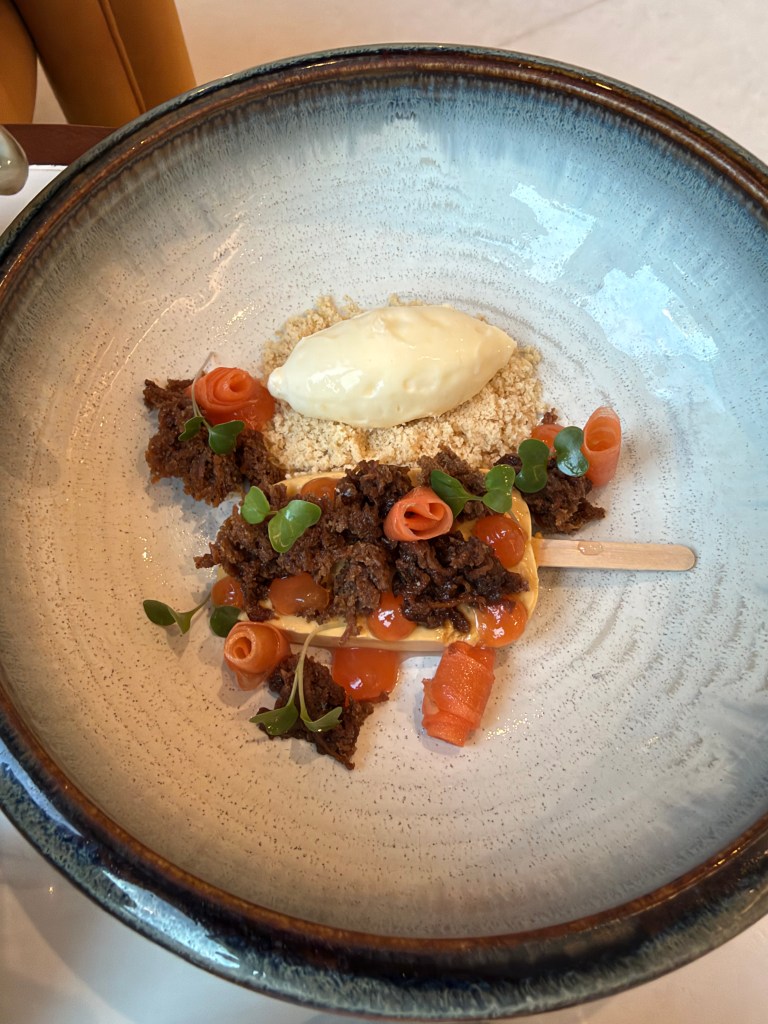
A food safety lapse of that kind is not a small thing anywhere, but it lands with particular force in a five-star dining room, where the entire premise on offer is that someone has already checked. A moldy pastry making it to a guest’s table means a link in that chain — kitchen to pass to service — simply wasn’t there that day.
What redeemed the moment entirely was a waitress named Angel. Genuinely mortified on the hotel’s behalf, she handled the situation with more composure and warmth than it deserved, and turned what could have been the low point of the trip into a moment of real hospitality. It’s worth naming her, because she illustrates the thesis of this entire piece more precisely than anything else could: luxury, when it actually shows up, shows up as a person — not a policy, not a design brief, not a five-star plaque in the lobby. The building didn’t recover that afternoon. Angel did.
Turndown service that evening happened only after I requested it, and even then felt hurried — a box checked rather than a ritual performed. Welcome amenities, still missing since day one, likewise had to be asked for rather than offered. By the second day, what had looked like an isolated oversight was beginning to look like the operating standard.
Day Three: The Wheels Come Off, Literally
Checkout day brought the story that turned a disappointing stay into a genuinely alarming one. The hotel’s valet service damaged one of my tyres. When I raised it, I was told, in effect, that it wasn’t the hotel’s problem, and that I should call the police myself.
I did. And then I waited. Four hours passed in the lobby before the police arrived — and it was only after their arrival that the Head of Security stepped in, took ownership of the situation, and arranged for the tyre to be replaced. He deserves real credit for how he handled it once he was in the room: decisive, apologetic, and effective. What he cannot undo is the four hours that preceded his involvement, or the fact that the intervention required a police presence to trigger it at all. Water and coffee were offered during the wait. Nothing more.
There is a principle worth stating plainly here: a valet operation running under a hotel’s name, parking cars on the hotel’s property for the hotel’s guests, is the hotel’s responsibility, regardless of the subcontracting arrangement behind the scenes. Guests don’t sign a separate contract with the valet company. They hand their keys to someone wearing the hotel’s uniform, standing beneath the hotel’s awning. That duty of care doesn’t dissolve because of a staffing decision made in a back office.
A quieter issue surfaced around the same time: a billing discrepancy from day one’s in-room dining, undercharged at the time, but never proactively corrected over the following two days. Instead, it appeared at checkout under vague language about “formalities.” Read generously, it was an administrative gap. Read plainly, it was a missed chance to be direct on a day the hotel needed, more than any other, to demonstrate exactly that.
So What Does “Five Star” Actually Measure?
Hospitality has spent the past decade perfecting what can be designed and photographed: minimalist interiors, curated scent, staff uniforms styled for an editorial spread. That investment is real and it isn’t nothing. But it’s also the easier half of the job. Design can be commissioned. It can be bought outright and installed on schedule.
What can’t be bought — what has to be trained, reinforced, and staffed for, shift after shift — is service recovery: what a property does in the minutes after something goes wrong. That is the actual test of a five-star rating. Any hotel can deliver a good stay when nothing breaks. The AC failure on day one wasn’t the test. The mold on the tart wasn’t the test. What happened immediately afterward, each time, was.
Measured against that standard, this stay fell short in nearly every place that counted:
- Recognition — a first-time, top-tier loyalty guest had to request the basics rather than receive them.
- Food safety — a lapse serious enough that it shouldn’t have needed a guest to catch it first.
- Financial transparency — a billing error resolved through vague language instead of a direct, timely conversation.
- Duty of care — four hours in a lobby, on checkout day, over a subcontracted service the hotel initially declined to own.
And it succeeded, unmistakably, in the two places where individual people simply decided to do the job properly without being asked twice: Angel at the lobby cafe, and the Head of Security once he finally entered the picture.
The Real Rating
Scored on facilities alone, this is close to a five. Scored on what a five-star rating is actually meant to signal — that a property will notice, own, and correct its own mistakes before a guest has to escalate them — it drops sharply, and the valet incident alone would be reason enough.
Luxury, at this point, isn’t the marble, the plating, or the amenity kit. Guests have stayed in enough hotels to stop being moved by the props. What they remember — and increasingly, what they now write about, in detail, for a public audience — is what happens the moment those props fail. A hotel’s true rating isn’t set at check-in. It’s set in the recovery, and that recovery is now happening in full view of guests with a phone and a TripAdvisor account.
The Anantara Downtown Dubai has the physical bones of a five-star hotel, and, in Angel and the Head of Security, proof that it also has the right people somewhere on staff. What it needs, urgently, is to close the distance between the two — so that the standard doesn’t depend on which member of the team happens to be on shift when something goes wrong.
Without End, Until It Ends
There is something almost poetic, in hindsight, about the name itself. Anantara is drawn from the Sanskrit for “without end” — a brand built on the promise of a journey that never really stops, an experience so seamless it dissolves the seams. It’s a beautiful idea. It is also, by definition, a promise that cannot survive a single dropped thread, because “without end” leaves no room for the moment a guest is told, mid-journey, that a problem is someone else’s department.
Loyalty, in theory, exists precisely to reinforce that promise — to signal, to a guest who keeps returning to a brand, that the brand recognises the relationship and treats it accordingly. On paper, my Titanium status with GHA Discovery, the alliance loyalty programme behind Anantara, should have meant an automatic upgrade, a welcome amenity waiting in the room, and recognition that didn’t need to be requested twice. That’s not a courtesy extended out of generosity; it’s a benefit the tier is built to guarantee, explicitly, in writing. When a guest has to ask for what GHA Discovery Titanium already promises them, the loyalty programme stops being a relationship and becomes paperwork the property hasn’t quite gotten around to honouring.
That is, in the end, what separates a five-star rating from five-star hospitality. The rating is awarded once, to a building, based on what it contains. Hospitality is re-earned every single day, by people, in the way they treat the guest standing in front of them — whether that guest is checking in for the first time or the fiftieth, whether the day is going smoothly or a tyre has just been damaged in the driveway. A brand name that means “without end” is, in effect, a promise to never let the guest feel the seam. This stay had several. What kept it from unravelling entirely wasn’t the brand. It was Angel, and it was a Head of Security who, once he finally stepped in, did the job properly.
That’s the real measure of luxury today: not whether a brand can design a beautiful promise, but whether it can keep it, especially on the day it’s hardest to. Until the systems around them consistently match what they’re capable of, the stars on the door describe the building. Not the stay.


Leave a comment